about me
i am sandra
Ever since I was little I have been surrounded by nature and a lot of my worldview is shaped by these early experiences. I was always playing in the forest and fields and I had a rich inner life. Every tree had a soul, each plant was a fairy and behind the next bush was a fairytale waiting to be played. I was taught to respect and rever Earth as our original mother.
Going to school from this dreamland that were my familiar garden and forest was quite a shock. I experienced bullying for over 5 years. It took a lot of courage to actually stay in school although I truly enjoyed learning and often read through older classes curriculums. I had migraines and a chronic skin condition for which (thankfully!) my parents seeked out every cure possible from Western medicine to Chinese and natural healers. From very early on I was introduced to a holistic view on the world and an understanding that nothing in our bodies happens by mistake and that there is a possibility to heal from inside out, not just manage the symptoms.
By the time I arrived to my early twenties I had been through multiple episodes of depression and burnt out twice. I was an excellent model for a “good girl” archetype while having both high functioning depression and anxiety. After burning out the second time all the facades fell and I was faced with who I am and who is it that I truly want to become. I recognized I had been living a life that society, family and other relations “expected” of me (actually it was I who did the expecting part). I had a degree cum laude from Estonias best university and a plan to become a teacher that shattered to pieces one night when I couldn’t sleep because of my anxiety. That night marked the end of a future I had carefully planned, but it also became the beginning of a deeper search for a life that felt truly my own.
I seeked ways to feel better mentally and emotionally and as once my parents had seeked help for my physical health, I now looked through every possibility from Western talk therapy to more holistic approaches. Therapy helped me back on my feet and to clear the brain fog that had been terrorizing me since the last burnout, but it was a medicine retreat in Spain where I suddenly got the realization and a vision of who I want to be and what I truly want to do. In this vision I was helping people heal with my hands.
After this I took my first module of MER bodywork and it truly felt like a homecoming. I had and still have an appetite for this work that seems to be never ending. I immersed myself in books on somatics, trauma work, emotional and physical body. But it sometimes felt like a piece was missing. Although my back and hip pain that had been with me throughout my university years disappeared, very painful menstrual cramps once a month remained no matter how much work I got done on my pelvis. Women’s health is often overlooked even in the field of somatics and I started to get curious – was there a way to support my female and other women’s physiology on a deeper somatic level?
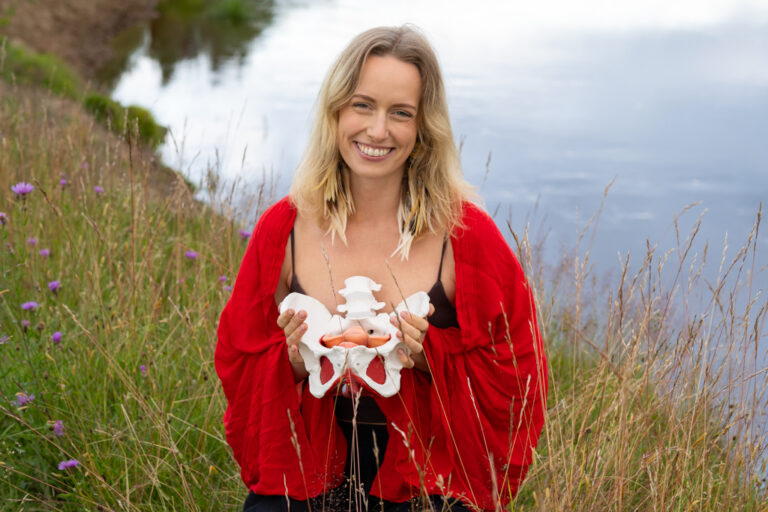
I then studied Mizan Therapy which is a holistic womb massage modality which also focuses on lifestyle, diet, movement and supplementation. A lot of things started to make sense. My cramps were not just random uncurable event that happened every month but rather a signal that my uterus is out of alignment and is causing pain because of this. What surprised me most was discovering how many symptoms women are taught to tolerate, rather than actually being looked into and finding the cause for them. Fix-for-all solutions for women’s health problems seem to be a) painkillers b) hormonal birth control (no cycle, no problem amiright) c) sentence “it’s all in your head, stress less”. In reality can these symptoms and issues often be improved through bodywork, adequate nutrition, addressing emotional root causes and making changes in lifestyle. With implementing this knowledge in my own life I truly have transformed my own menstruation and my relationship with my cycle. Being a woman no longer means being a junior man (as one author so poignantly put it) but being a human being that has it’s innate physiological wisdom and systems that deserve our attention. Our cycle and fertility are not to be suppressed, but lived in harmony and balance with. From this understanding stems my approach to women’s bodywork.
Women deserve care that is specialised to our female physiology, body, mind and spirit. A lot of the medical research even today is done mostly on men and by men (and before the year 1993 research on women was not mandatory). I believe our generation is here to break that cycle and story of looking at female health through a male lens. Women’s bodies need to be heard, witnessed and supported through all the phases of life from birth to menarche to menopause and beyond. One of the most remarkable aspects of being a woman is our cyclical nature, where no two days are the same. How can we expect care and support be the same throughout all our cycles of life if they are everchanging?